Education
Free video series for educators · 4 parts
Beyond Compliance: Building Neuroaffirming Autism Classes
All you need to know about what a neuroaffirmative classroom should look like, from someone who has already done it.
A four-part talk for educators by Jane O'Neill, Director of Thrive Hub at Neurodiversity Ireland, drawing on her experience as an autism class teacher. Each part has a video, the slides and a short visual handout to keep.
- NCSE Relate Framework
- Total communication
- PDA
- Gestalt Language Processing
- Monotropism
- Child-led learning

Your speaker
Jane O'Neill
Director of Thrive Hub, Neurodiversity Ireland
Jane taught in an autism class in a mainstream primary school until June 2026: six children, three staff, and a classroom built around the children rather than the timetable.
She is a neurodivergent advocate with a passionate interest in neurodiversity-affirming, child-led learning, and learned about Autistic people from Autistic people.
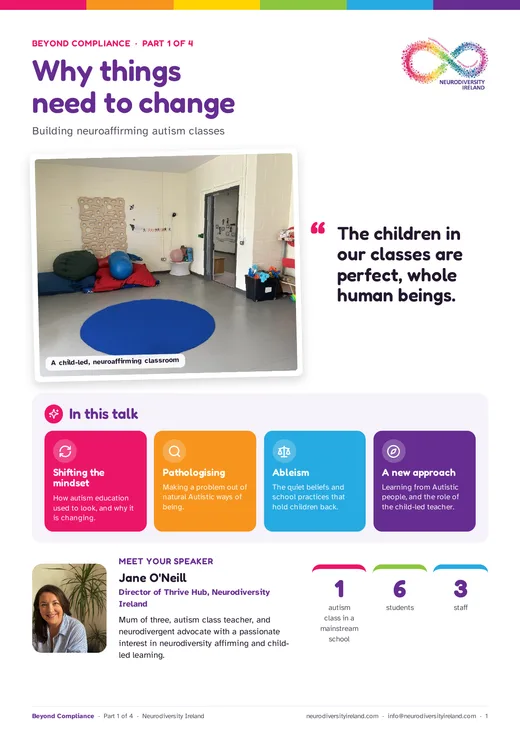
Part 1 of 4
Why things need to change
Shifting the mindset, pathologising, ableism, and the role of the child-led teacher.
In this part
Why the old model of structured, adult-led, compliance-based autism education no longer fits, from pathologising and ableism in school policies to the role of the child-led teacher.
- Context: a child-led autism class in a mainstream school
- Shifting the mindset away from deficit and control
- Behaviourism, ABA and the UNCRPD
- What pathologising looks like in school
- Ableism in everyday school policies
- The role of the child-led teacher, and our philosophy

Part 2 of 4
Our non-negotiables, and understanding PDA
Unconditional positive regard, the double empathy problem, monotropism, transitions, capacity, and PDA (Persistent Drive for Autonomy).
In this part
The five non-negotiables of a neuroaffirming autism class, the Double Empathy Problem, monotropism and flow, predictability without rigidity, and what every educator needs to understand about PDA.
- Our five non-negotiables
- Unconditional positive regard
- The Double Empathy Problem
- Monotropism, transitions and flow
- Predictability, not rigidity, and honouring capacity
- PDA: Persistent Drive for Autonomy

Part 3 of 4
NCSE Relate, planning and assessment
Using the NCSE Relate Framework for planning, observation, assessment and neuroaffirming goal setting.
In this part
Using the NCSE Relate Framework day to day: the Relate toolkit, planning requirements, neuroaffirming observation and assessment, Student Support Plans and meaningful goal setting.
- The traditional autism education setting
- The NCSE Relate Framework, and why it matters
- Your Relate toolkit
- Planning requirements in autism classes
- Neuroaffirming observation and assessment
- Student Support Plans and neuroaffirming goal setting

Part 4 of 4
The classroom in practice
Setting up the physical classroom, strewing, cause and effect, Gestalt Language Processing, and connection.
In this part
Setting up the physical space, equipment, strewing, cause and effect, Gestalt Language Processing, connection seeking, and working with families, management and all staff.
- The physical classroom and the sensory environment
- Recommended equipment, and a word on safety
- Strewing
- Seeking predictability: cause and effect
- Gestalt Language Processing
- Connection seeking, families, management and all staff
Who this series is for
Teachers, classroom assistants, principals and school leaders, especially anyone opening or working in an autism class. Parents and carers are welcome too: it will help you know what to look for and what to ask for.
How to use it
Watch the parts in order or start where you need to. Each part has a two-page handout to print, share at a staff meeting, or keep in your planning folder. Training is an advantage, but not essential: the NCSE Relate Framework can be printed off and used as your guide.
Questions about the series or training for your school: info@neurodiversityireland.com
These videos and handouts are for general information and do not replace individual clinical or educational advice.
Education-Related Resources
Coming soon