A Neurodiversity Ireland initiative
The NDI Thrive Hub
Ireland's first purpose-built “unschool” for neurodivergent children. It is proof that a child who cannot sit in a classroom can still get an education, when the classroom finally adapts to them.
First floor, NDI Centre of Excellence for Neurodiversity, 2-4 Claremont Road, Sandymount, Dublin 4
The crisis in Irish education
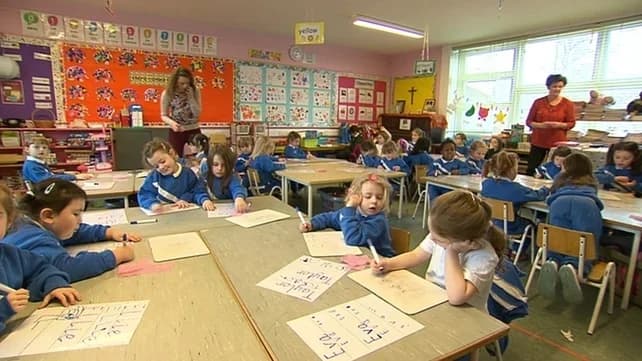
Ireland is failing its neurodivergent children
Tusla's School Attendance campaign says 1 in 5 children miss 20 or more days of school. Every week we wait, another neurodivergent child is pushed out of a school system that was never built for them.
c.200,000
children are not in school full time
3,000+
children with no specialist school place for September 2026
25,000+
children overdue for an Assessment of Need (AoN), with up to 80,000 in the system. No overall data is published. An AoN is a legal prerequisite for support.
91%
of children unable to attend school full time are neurodivergent
Largest
class sizes in the EU: a system built for compliance, not for children
Age 5
Children as young as five are unable to attend school, reporting full breakdowns, a significant loss of everyday capacity and suicidal ideation
Sources: Tusla Education Support Service (TESS), 1 in 5 children not attending school full time, 2022-2023. The 3,000 figure was quoted at the Dáil parliamentary committee when the Department of Education was questioned about the number of children with no school place. The INTO regularly cites Ireland as having the largest class sizes in the EU.
NDI school survey: 348 children, late 2025
We asked families. The answer was clear.
Not truancy. Not choice. A generation of neurodivergent children whose nervous systems cannot tolerate the only environment the State offers them.
92.8%
cannot attend school full time, or attend only part time
91%
of children unable to attend are neurodivergent
54%
missed more than 50 days across the last two school years
85%
are, or may be, PDA: a Persistent Drive for Autonomy
2 in 3
are waiting on the Health Service Executive (HSE) for assessment or support, with no help in the meantime
What the numbers mean
This isn't defiance. It is survival mode.
Children cannot learn, reason or engage until they are regulated. Everything about the Thrive Hub starts from that single, evidence-based fact.
Not misbehaviour
What looks like refusal is a protective response to a nervous system that feels unsafe. Learning is neurologically impossible until a child is regulated. Too often, a child's distress is treated as defiance until their body stops working completely.
Compounding risk
The children on NDI's waiting list are among those most at risk of school breakdown, Autistic burnout, suicidal ideation and eating disorders. We work at the coal face of childhood distress caused by a school system that has not changed in 60 years. Our workplaces must be safe. Why not our schools?
No door to walk through
No diagnosis or assessment is needed to access the Thrive Hub, because no family in crisis should have to wait for a label before they get help.
The impact on children
What we see every day
Neurodiversity Ireland has a waiting list of 400 children and growing: children in crisis, and families who need support and who are overwhelmingly unable to attend school. When a child's nervous system is under this much pressure, every part of daily life is affected.
Eating
Children unable to eat; restrictive eating and eating disorders arising from nervous-system stress.
Sleeping
Basic needs, such as falling and staying asleep, are significantly disrupted.
Safety
Self-harm, suicidal ideation, OCD behaviours, head-banging, running away and hurting others, all arising from bodies and minds under far too much pressure.
Communication
Children's ability to communicate and take part in daily life suffers under nervous-system stress.
Daily life
Children struggle to leave their beds and rooms, and to manage everyday tasks including toileting and washing.

Open access
Parents of children who cannot attend school are facing prosecution, not compassion. Classroom environments that do not meet neurodivergent children's needs, and cultures of rewards and consequences that work as threats, are not increasing attendance. They are driving children out of school altogether.
Our founding principle: the NCSE Relate Framework
We ask a different question
“How do we make this child tolerate school?”
“What kind of environment allows this child's nervous system to feel safe enough to learn?”
Regulation
before expectation
Safety
before compliance
Connection
before correction
The Relate Framework is published by the National Council for Special Education (NCSE).
What we mean by an "unschool"
Built around the nervous system, not the timetable
Not homeschooling. A recognised alternative education model: self-directed but scaffolded.
Self-directed, not self-taught
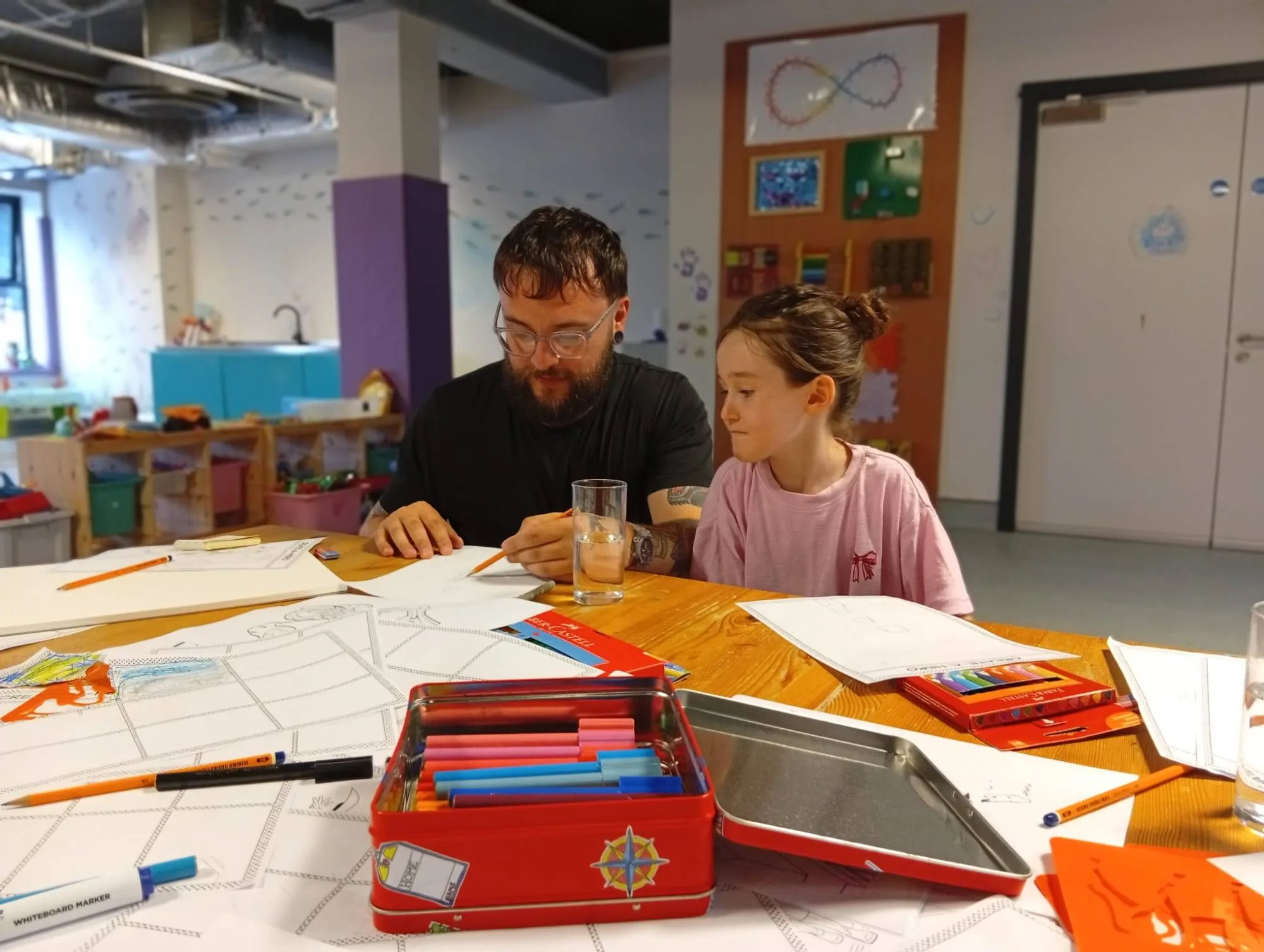
Children choose what, when and how they learn, immersed in their deep interests. It is an apprenticeship model of learning, not a fixed curriculum on a fixed day.
Scaffolded, not top-down
Modelled on the Sudbury tradition of Trust, Freedom and Responsibility, with a School Meeting where children's votes carry real weight. That includes children who communicate other than by speech, supported by Ireland's first Augmentative and Alternative Communication (AAC) and Assistive Technology (AT) Lab.
Regulation first, not compliance first
No bells, no fixed timetable, no forced participation. When the demand disappears, a PDA nervous system can finally show up to learn.
Every child at the Thrive Hub attends by choice, not compulsion, because for a PDA nervous system, compulsion is what breaks attendance in the first place.
Three principles, built into every room
Regulation, safety and predictability
Sensory-attuned, predictable environments; total communication; consistent co-regulation from trained staff.
Autonomy and monotropic learning
Child-led pathways with no unnecessary pressure. Deep interests become the engine for literacy, numeracy and growth.
Environment as therapy
Flexible time, movement and pacing. Staff are trained as co-regulators, never as enforcers of behaviour.
What regulation-first looks like
Reference images from our design brief: cool, spacious, nature-connected spaces that remove stressors and allow children the freedom and space and autonomy to access regulation needed to learn.
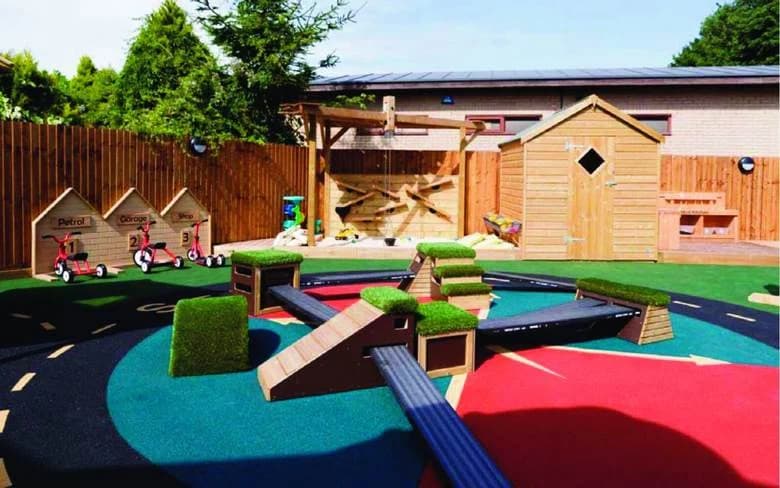
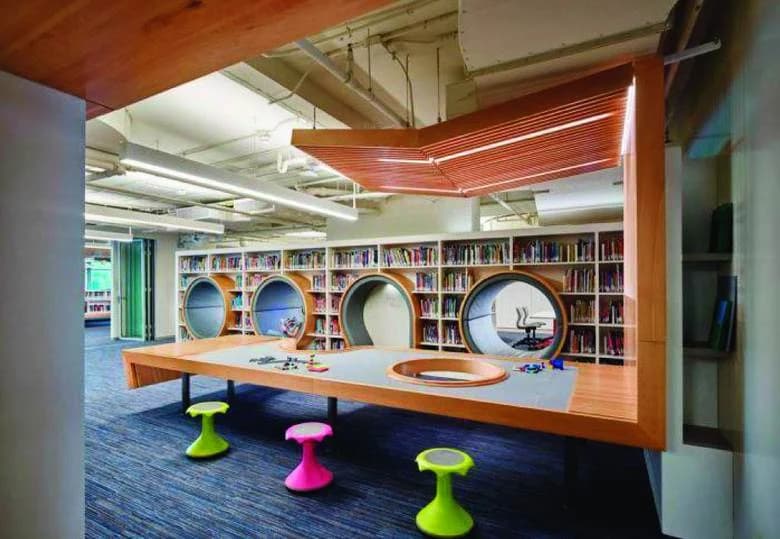
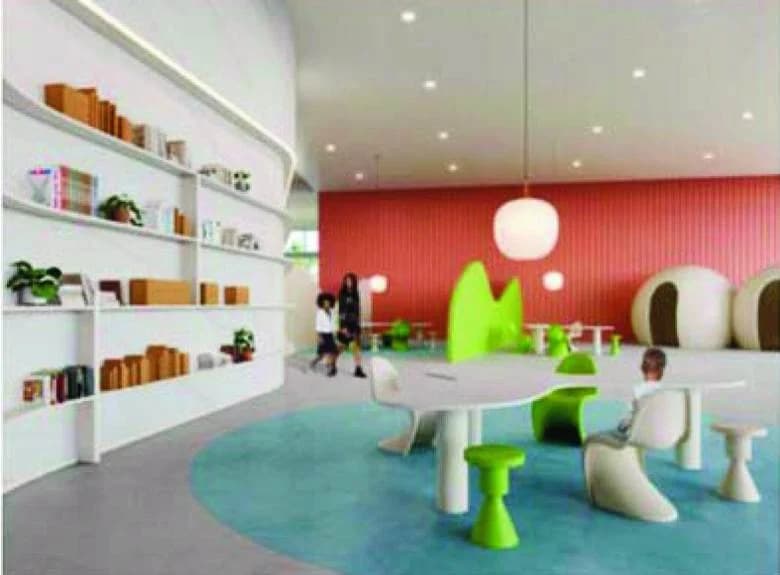
Illustrative design references, not photographs of the Sandymount premises.
How we support children
Six ways the Thrive Hub supports every child
One roof and one clinical team, teaching children directly while equipping parents to advocate and changing how teachers teach, for every child in the room.
“Unschool” days
Full time and part time, in person and online, during term time. Occupational therapy (OT), speech and language therapy (SLT) and AAC are built in, for children who cannot access school at all.
Holiday programmes
Support that continues when term-time provision usually stops, with therapeutic respite when families need it most.
Family support and coaching
One-to-one clinical consultations, group coaching and peer networks. Many parents are in crisis too, and their support is not an afterthought.
Parent advocacy training
Practical training so parents know what to ask for, what exists and how to get it: Assessment of Need, school supports and statutory processes.
Dyslexia-specific supports
Dedicated parent information sessions and how-to guides for dyslexia, alongside our wider neurodivergent offering.
Teacher professional development
Webinars, accredited courses and in-person continuing professional development (CPD) that show educators how to teach neurodivergent children in ways that benefit every child in the room.
No diagnosis is required for any of the six, and no profile is excluded: Autistic, ADHD, PDA, dyslexic, or none. We support the need in front of us.
A closer look
Literacy, communication and advocacy
Dyslexia support that has caught up with the evidence
As many as 1 in 5 children show signs of dyslexia. Most will never get one of the handful of places in a specialist reading school.
Structured, evidence-based literacy.
Explicit, systematic phonics and structured literacy grounded in the Science of Reading, not Reading Recovery, which is still being offered to schools in 2025/26 despite the evidence having moved on.
No waiting list, no lottery.
Catherine McAuley School received 161 applications for 52 places in 2024/25. The Thrive Hub is built to meet the need directly.
Built for neurodivergent profiles.
Support for dyslexic children who are also PDA, Autistic or ADHD, including Gestalt Language Processors, whose route into language and literacy most reading programmes are not built to recognise.
Sources: Dyslexia Ireland; Oide, Reading Recovery Expression of Interest 2025/26. International estimates of dyslexia range from 4% to 20%, depending on the definition used.
Every child gets a voice and an education
Minimally speaking and non-speaking children are too often shut out of learning. Our in-house SLT and AT service makes sure every child at the Thrive Hub can access the same education as their peers, however they communicate.
In-house SLT, not a waiting list.
Speech and language therapy is built into every unschool day, holiday programme and family session, not a referral to a multi-year queue.
Ireland's first AAC and AT Lab.
Every non-speaking or minimally speaking child has the right device, system and vocabulary to take part fully: in lessons, in the School Meeting and in everyday life.
Gestalt Language Processing informed.
Clinicians trained in Gestalt Language Processing meet children who learn language in scripts and chunks with the right approach from day one.
For parents
Irish exemption support.
Step-by-step guidance through the Department of Education's exemption criteria and application, from the assessment threshold to the appeal window.
Assistive technology guidance.
Finding the right AT for a dyslexic child (text-to-speech, audiobooks, word processors, mind-mapping tools) and getting schools to provide it.
Peer support network.
One-to-one consultations plus WhatsApp groups by area, dyslexia, ADHD and more, with parents who have navigated the same systems.
For teachers
Classroom-ready training.
Practical, regulation-first strategies for supporting neurodivergent children day to day, including sensory awareness and communication, delivered in real classrooms, not just in theory.
A real education, not a placeholder
Led by neurodivergent educators and clinicians
The Thrive Hub follows the Department of Education Primary Curriculum, so children can move in and out of mainstream education as and when they are ready.
- Up to 60 students per day
- 1 staff member to every 2.5 students
- Pilot: 20 children aged 7 to 11
- Dedicated NDI Dyslexia Service
Jane O'Neill
Director of Thrive Hub
Ciaran Gaynor
Senior Occupational Therapist, AuDHD and PDA
Sinead Kerley-Dunne
Speech and Language Therapist: Gestalt Language Processing, AAC and Childhood Apraxia of Speech
CJay Smith
Assistive Technology and Communication Specialist
Emily O'Shea
Speech and Language Therapist
The premises
The first floor completes the Sandymount campus
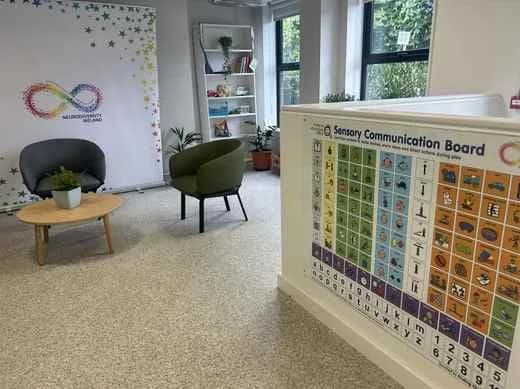
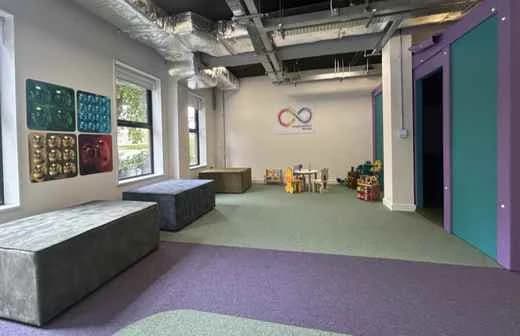
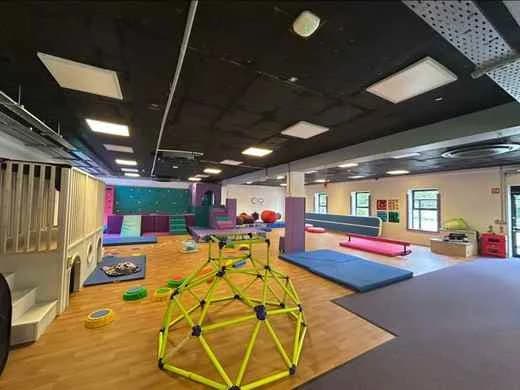
We have created Ireland's first purpose-built Centre of Excellence for Neurodiversity at 2-4 Claremont Road, Sandymount. The Thrive Hub, on the first floor directly above our Sensory Centre, completes the campus: almost 11,000 square feet across four dedicated group spaces, with room to grow. Children will have occupational and speech therapy, group-based play and an alternative education setting, all in one centre at the heart of the community.
Our track record
We have already shown this model works
Our Regulate:Participate! pilot, funded by the Department for Disability through Rethink Ireland (DPAF 2023), was delivered in person, school by school.
100%
of staff found the training applicable to their classroom and were satisfied with its quality
5,000
teachers and educators have attended our CPD events to date
25
national partners already train with us, including Tusla, the HSE, INTO, FORSA, Mary Immaculate College, Maynooth University, Tallaght University Hospital, the Mater Hospital and Children's Health Ireland
“This was probably the most helpful and influential CPD I've ever done. It was hugely informative.”
From summer camps to a national movement
Neurodiversity Ireland is Ireland's leading neurodiversity charity and a Disabled Persons' Organisation. Our team is almost entirely neurodivergent, bringing lived experience to the work.
2022
Neurodiversity Ireland begins with two-week Summer Camps, a vital social outlet for children who had nowhere else to go.
Clinical supports scale up
Our pilot Sensory Centre grows to support 200 children a week with OT-guided peer play and interest groups.
Training goes national
144,000+ educators and public sector staff reached through INTO and FORSA, and 1,500+ early years educators trained with Mary Immaculate College.
2025
Our first NDI Summit brings policymakers, educators and families together at Trinity College Dublin.
Centre of Excellence
HSE funding secures the lease of 2-4 Claremont Road, Ireland's first Centre of Excellence for Neurodiversity.
2026
204 children enjoy our Summer Camps, and 25 national partners now train alongside us as we build toward the Thrive Hub.
What the Thrive Hub will make possible
For the children in crisis, right now
400
children supported each year at full capacity, with 60 attending in person each day across four groups of up to 15
4,000
schools able to use our resources, webinars, courses and teacher professional development
10,000s
of students and families supported through our on-demand education resources and guides
The Thrive Hub is the first of its kind in Ireland. No equivalent PDA-informed provision exists anywhere in the State. It is backed by the United Nations Convention on the Rights of Persons with Disabilities (UNCRPD), ratified by Ireland in 2018 (Articles 7, 19, 24 and 26), and aligned with the National Disability Strategy 2025-2030.
Get involved
Back Ireland's first Thrive Hub
The premises are identified, the educational model is designed and the Director is appointed. The families are waiting. We are now looking for founding partners to fit out the first floor and fund the first year of care. Founding partners put their name behind the first “unschool” of its kind in the history of the State.
- Premises identified
- Educational model designed
- Director appointed
Families:
Families should follow Neurodiversity Ireland to learn more about our drop in sessions coming soon and look out for more news about the Thrive Hub on our social media channels. To express an interest contact info@neurodiversityireland.com
To talk to us about becoming a founding partner, or about a place for your child, email info@neurodiversityireland.com
Email us about the Thrive HubNeurodiversity Ireland is the trading name of Neurodiversity Sandymount CLG. Registered charity RCN 20206465. Company No. 717523. CHY 23074. 2-4 Claremont Road, Sandymount, Dublin 4.